
How Hot Air Balloon Flights Work in Melbourne
Most visitors waking up before dawn around Yarra Park expect a set itinerary, but balloon flight paths melbourne pilots navigate change with every shift of the morning breeze. You cannot steer a hot air balloon like an airplane. There is no rudder, no hidden propeller beneath the basket, and absolutely no reverse gear. Instead, taking a hot air balloon flight melbourne style means putting your entire morning into the hands of gentle atmospheric physics and a veteran balloon pilot who reads invisible layers of wind drifting over the city skyline.
Melbourne is one of the very few major global capitals where commercial hot air balloon flights melbourne operators can actually drift right through the central business district. It looks effortless from down on the pavement when you see an air balloon melbourne commuters stop to photograph near the MCG. Behind the scenes, making that happen requires obsessive weather monitoring, tight coordination with civil aviation radar, and dozens of rapid micro-adjustments with the burner valve.
How Winds Determine Balloon Flight Paths Melbourne Skywatchers See
To understand ballooning melbourne mornings, you have to picture the atmosphere above Port Phillip Bay as a slow, stacked cake. Wind does not blow in a single direction from the ground up to four thousand feet. At street level in Richmond, cold air might pool dead quiet, while at five hundred feet a gentle northerly slides toward St Kilda, and at two thousand feet a southwesterly pushes back toward Box Hill. A skilled hot air balloon pilot uses these conflicting layers to steer.
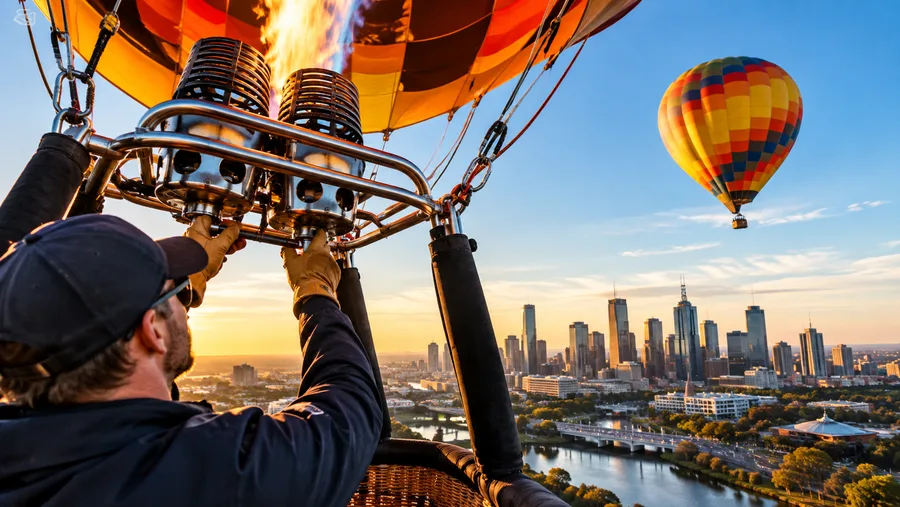
By firing the twin burners, the pilot heats the nylon envelope, making the craft climb into a higher wind shelf going southeast. Venting hot air through the parachute valve at the top drops the balloon into a lower current heading due south. That vertical control is the sole method used to zigzag across suburbs. It requires endless patience, precise timing, and years of logging local air quirks.
Every commercial trip starts around 4:15 am in a hotel lobby or warehouse base. The pilots spend forty minutes scrutinizing live isobar maps, Bureau of Meteorology soundings, and telemetry from nearby airports before anyone touches a basket. If the wind speed exceeds 11 knots at ground level or gusty shear sits low over the Yarra, the trip gets called off immediately. You can read up on the precise weather conditions for hot air ballooning in melbourne to see just how tight those margins are.
Pro tip: Keep your morning schedule completely clear until at least 11:00 am. Even though you land before breakfast, pack-down and retrieving the trailer take longer than most people expect.
Book your hot air balloon melbourne experience:
Common Launch Sites and Where the Baskets Drift
Because you go wherever the morning breeze goes, operators cannot use a permanent launch pad. Melbourne ballooning teams own permissions for roughly 17 different public parks, ovals, and reserves scattered across inner metropolitan Melbourne. The crew loads the deflated envelope onto a tandem trailer, monitors miniature helium pilot balloons sent aloft at 5:00 am, and only then picks the morning launch site.
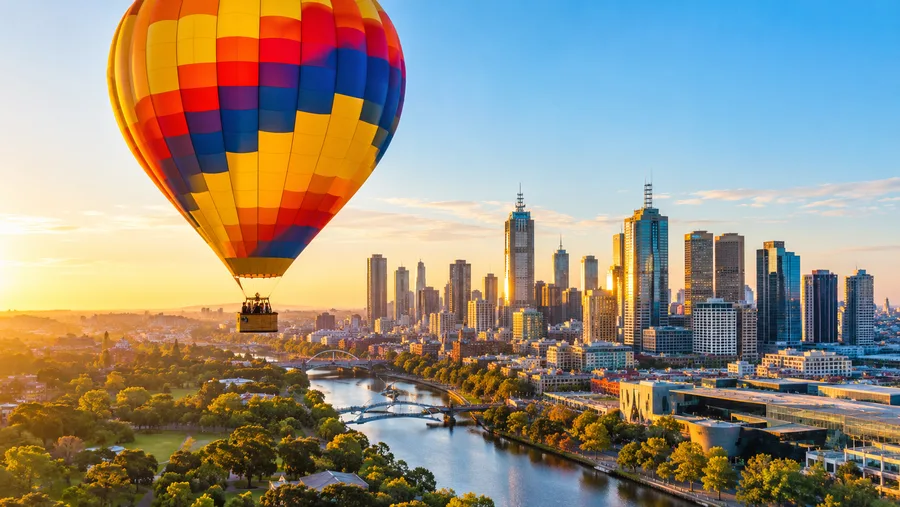
If winds drift gently from the north or northeast, launches typically happen around Royal Park in Parkville, Princes Park in Carlton, or Yarra Bend Park in Fairfield. That drift carries the basket straight over the skyscrapers, tracing Flinders Street Station, the botanical gardens, and out toward Albert Park. On mornings when southwesterlies dominate, the team drives out to Moorabbin, Glen Waverley, or Doncaster, letting the breeze pull the basket across the eastern suburbs toward the Dandenong Ranges.
| Launch Location | Prevailing Wind Direction | Typical Flight Path | Average Altitude |
|---|---|---|---|
| Royal Park (Parkville) | Light North / North-Northwest | CBD towers, Southbank, Albert Park Lake | 1,200 to 2,500 ft |
| Yarra Bend (Fairfield) | North-East | Richmond, MCG, Botanical Gardens, St Kilda | 1,500 to 3,000 ft |
| Albert Park Reserve | South / South-Southwest | Docklands, Footscray, Maribyrnong River | 1,000 to 2,000 ft |
| Collingwood College Oval | North-Northwest | East Melbourne, Fitzroy, Prahran | 1,800 to 2,800 ft |
Landing is always an unscripted affair. Pilots carry detailed satellite maps marking every park, cricket pitch, and school ground across greater Melbourne. They identify primary and secondary landing targets while still hovering 1,500 feet up. A good pilot aims for a generous patch of grass like Fawkner Park, but sometimes they touch down neatly on a neighbourhood sports ground in Hawthorn while early dog walkers watch in utter disbelief.
Airspace Sharing and Tracking over the City
Melbourne airspace is crowded. Tullamarine handles international jumbo jets, Essendon moves regional charters and air ambulances, and Moorabbin bustles as Australia's busiest flight training hub. Slotted directly in the middle of these flight corridors are several eight-story-tall baskets carrying tourists. It works only because melbourne balloon flights operate under strict instrument flight rules overseen by Airservices Australia.
Long before dawn, the flight leader phones Essendon tower to file an operational briefing. Once airborne, every basket carries an aviation VHF transponder, a two-way radio tuned to tower frequencies, and modern GPS equipment. Ground crews and aviation geeks follow the action live on a digital hot air balloon tracker, watching altitude hops and drift tracks as envelopes float past Eureka Tower.
Here is what happens inside the cockpit area while passengers snap photos of sunrise:
- Continuous tower communication: Pilots report positions at mandatory visual reporting points like the Bolte Bridge, West Gate Bridge, or the MCG light towers.
- Altitude caps: Air traffic control assigns strict ceilings, usually holding baskets below 3,000 feet so commercial airliners on arrival tracks into Tullamarine have complete separation.
- Visual vigilance: While air traffic controllers maintain radar coverage, the pilot maintains constant 360-degree visual scans for news helicopters and medical flights inbound to the Alfred Hospital helipad.
- Chase team monitoring: The pilot relays street coordinates every 8 minutes so the recovery van can navigate morning traffic and reach the landing clearing before the basket settles.
Note: Air traffic control can order a pilot to change altitude immediately or terminate a flight early if unscheduled air traffic enters the Melbourne control zone.
Book your hot air balloon melbourne experience:
The Anatomy of an Urban Hot Air Balloon
People often imagine a hot air balloon is primitive gear, but city flying demands specialized commercial hardware. The fabric envelope is made from high-tenacity ripstop nylon, reinforced with structural load tapes that bear the entire weight of passengers and fuel cylinders. The upper portion, exposed to intense heat from the burner blasts, uses silicone-coated Nomex fabric that resists temperatures over 120 degrees Celsius.
Beneath the fabric hangs the burner frame, running twin or triple liquid propane burners pumping out roughly 15 to 20 million BTUs an hour. That is enough raw heat output to warm several hundred suburban homes simultaneously. The pilot squeezes a blast valve trigger to deliver hot lift, or cracks a whisper burner - a quiet, low-pressure nozzle designed to avoid startling horses, dairy herds, or sleeping inner-city pets during low passes.
The basket itself is woven by hand from traditional cane and willow. Modern materials like carbon fibre or aluminium have been tested extensively, but nothing absorbs the ground impact of a brisk landing quite like flexible woven willow. Inside, partition walls separate guests from the pilot and the upright stainless steel fuel tanks, which carry about 180 litres of high-grade liquid propane per trip.
It smells faintly of sweet gas and morning dew up there. The quietness takes you off guard. Between burner blasts, the flight is completely silent, drifting at the exact speed of the surrounding air so you feel zero wind against your face.
Ground Crew Operations and Recovery
For every melbourne hot air ballooning pilot in the sky, there are at least two or three crew members on asphalt driving a heavy-duty four-wheel-drive with a massive custom trailer. The chase crew is the unsung backbone of the entire operation. They do not just drive around waiting; they predict street turns, navigate peak-hour tram tracks, and secure park gates so recovery can happen without drama.
When the pilot initiates final approach into an urban reserve, the ground team is often already standing at the oval perimeter. If winds are fresh, crew members grab drop lines thrown from the basket to guide the craft gently onto open turf and avoid garden beds or goalposts. Once down, the pilot pulls the rapid deflation rip line, collapsing the 400-kilogram envelope in seconds.
Packing down is communal and surprisingly physical work. Pilots often invite passengers to jump in and help squeeze residual air out of the canvas tube before rolling it into a heavy canvas duffle bag. You get grass stains on your shoes, laugh with strangers, and earn the cooked breakfast that follows.
Practical Tips for Passengers Taking to the Melbourne Sky
If you are booking hot air ballooning in melbourne for the first time, a few practical realities will make your morning run far smoother:
- Footwear matters most: Wear flat, waterproof shoes with wool socks. Parks and golf fairways are soaked with morning dew, and soggy sneakers will ruin your breakfast afterward.
- Layer your clothing: It is chilly at 5:00 am in a car park, but standing directly beneath a 15-million BTU burner means the top of your head will get quite warm during flight. Wear a beanie or brimmed cap.
- Leave oversized bags behind: Space inside the basket is tightly calculated by passenger weight and volume. Carry only your phone, camera with a wrist strap, and sunglasses.
- Keep your schedule flexible: Balloon rides melbourne operators cancel roughly 30 to 40 percent of flights due to rain, low cloud ceilings, or erratic wind speeds. Always book for your first morning in town so you have backup dates available.
Understanding the balance between atmospheric winds and pilot skill transforms how you watch a melbourne hot balloon drift over the suburbs. It is not an amusement park ride with rails and predictable schedules. It is genuine aviation, governed by natural geography and centuries-old aerodynamic laws, played out against a gorgeous modern cityscape.
Frequently Asked Questions about balloon flight paths melbourne
Can hot air balloon pilots steer where they land in Melbourne?
Pilots cannot steer directly left or right with a mechanical wheel. They steer by changing altitude to catch different air layers blowing in different directions. By ascending or descending a few hundred feet, a pilot can alter heading by 30 to 90 degrees to aim for a suitable park or reserve.
Why do balloons only fly over Melbourne at sunrise?
Morning provides the most stable atmospheric conditions. As the sun rises and warms the earth, the ground produces thermal updrafts and gusty wind turbulence that make urban ballooning unpredictable and unsafe. Early dawn offers cold, calm air and minimal wind shear.
What happens if a balloon runs out of fuel over the city?
Pilots carry enough fuel for more than two hours of continuous flight, even though typical trips last roughly an hour. Rigorous pre-flight checks ensure significant reserve fuel is available to clear built-up residential areas and find an open park safely.
Quick Reference
- Launch decisions made daily around 5:00 am
- Cruising altitude between 1,000 and 3,000 feet
- Winds under 11 knots required for urban flights
- Total flight duration roughly 50 to 70 minutes
Book your hot air balloon melbourne experience:
Before You Go
Standing on a dew-drenched oval before sunrise watching twin burners inflate an eight-story envelope is an experience that stays with you long after the trip finishes. If you want an unmatched view of the bay and the awakening grid of streets below, secure a spot on an early morning flight, dress in warm layers, and let the wind decide where your day begins.
Read more about hot air balloon melbourne.