
Hot Air Balloon Flights vs Balloon Rides What's the Difference
Most people use the terms interchangeably when browsing holiday brochures or scrolling social feeds, but ask a veteran pilot and they will gently set you straight. Booking a journey above the treetops exposes you to a whole spectrum of aviation, starting with the actual types of hot air balloon built for different altitudes, passenger counts, and wind tolerances. The language people use often hints at the style of outing they expect, whether that means a carnival-style float tied to the ground or a genuine cross-country aerial voyage.
Whether you call it a flight or a ride changes how you prepare, what gear you pack, and what you get for your money. Some operators sell quick tethered hops at weekend festivals, while licensed aeronauts run full-scale dawn expeditions governed by strict civil aviation rules. Here is a breakdown of what separates casual sightseeing from genuine lighter-than-air navigation, along with the equipment that gets you off the grass.
Book your hot air balloon melbourne experience:
Aviation Reality vs Amusement: The Core Distinction
Words matter in aviation. Technically speaking, an aircraft registered with civil aviation authorities undertakes a flight. It operates under air traffic control oversight, follows weight-and-balance manifests, and depends entirely on atmospheric currents for steerage. You board at Point A and land wherever the wind deposits you at Point B, usually somewhere between 5 and 18 kilometres away.
A "balloon ride" often colloquially describes shorter, stationary experiences. Think of county fairs or winery events where a basket floats 30 metres into the morning chill while anchored to heavy 4WD vehicles with thick steel cables. You climb in, ascend for five minutes, snap three photos, and descend so the next group can step aboard. It offers a taste of altitude, but it lacks the genuine rhythm of unanchored flight.
Note: Some commercial outfitters label their genuine cross-country voyages as "rides" purely because everyday travellers search for that phrase online. Always check whether the itinerary mentions a free-floating journey or a tethered setup before paying your deposit.
There is also an emotional difference. A tethered ride feels like a fairground attraction, complete with engine noise from ground winches and lines of waiting tourists. A free-floating flight feels peaceful, almost eerie, once the burner valve shuts off and you drift at the exact speed of the breeze around you.
Envelope Designs and Different Types of Hot Air Balloon
Not every aircraft drifting overhead shares the same engineering. Balloons fall into distinct technical categories based on how they generate lift and how their fabric envelopes are shaped. When exploring the various types of hot air balloon used around the world today, pilots generally split them into Montgolfier designs, hybrid gas systems, and promotional oddities.
The standard Montgolfier design dominates passenger tourism. It relies purely on propane burners heating the ambient air trapped inside a ripstop nylon or polyester envelope. These envelopes range from modest 77,000-cubic-foot envelopes carrying two people up to massive 500,000-cubic-foot giants carrying 24 passengers in partitioned wicker compartments. If you want to know more about the mechanics of how these burners and envelopes handle local wind layers, take a look at how hot air balloon flights work in Melbourne before your trip.
Here are the common variations you might encounter across clubs, festivals, and tour operations:
- Standard inverted teardrop: The classic aerodynamic shape built for fuel efficiency and predictable vertical control in stable morning air.
- Special shape envelopes: Custom-built promotional giants shaped like animals, beer cans, or historic buildings, notoriously hard to handle in wind speeds above 6 knots.
- Hopper balloons: Tiny solo rigs where the pilot sits on a bicycle-style saddle or harness with a single propane tank strapped to their spine, skipping the basket entirely.
- Rozière hybrid balloons: Long-distance envelopes combining a non-pressurised hot air chamber with a sealed helium cell, built specifically for circumnavigation attempts.
Watching a hopper take off is wild. It looks like someone strapped a camping burner to an office chair and floated away into the fog. Commercial outfits never use them for paying customers, but seeing one launch at an autumn rally shows you just how simple thermal lift can be.
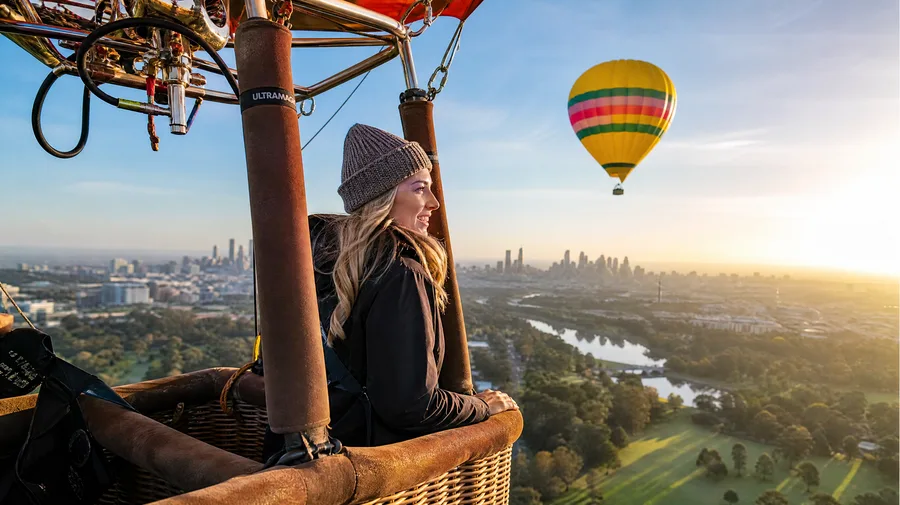
Commercial Flight Packages vs Simple Tourist Rides
The operational gap between a casual tourist hop and a premier morning flight shows up in the paperwork, the ground team, and the itinerary length. A proper flight takes roughly four hours out of your day, even if the basket is only airborne for 55 to 70 minutes.
| Feature | Tethered Balloon Ride | Commercial Dawn Flight | Private Adventure Flight |
|---|---|---|---|
| Duration Aloft | 5 to 10 minutes | 50 to 75 minutes | 60 to 90 minutes |
| Max Altitude | 30 to 45 metres | 600 to 1,200 metres | 900 to 1,500 metres |
| Passenger Capacity | 4 to 6 rotating | 10 to 24 per basket | 2 to 4 guests |
| Typical Cost (AUD) | $25 - $50 | $350 - $480 | $1,400 - $2,200 |
| Landing Routine | Winched to pad | Variable paddock landing | Pilot-selected rural spot |
Cost reflects that infrastructure. For an open-air flight, you are paying for the pilot's commercial licence, several thousand dollars worth of aviation liability insurance, a chase crew driving a trailer to fetch you wherever you land, and hundreds of litres of fuel. If you are comparing quotes across Victoria, reading about balloon tours in Melbourne what's included will save you from surprise gear hire or breakfast charges down the line.
Tethered rides cut those expenses to the bone. Because the balloon never unties, the operator does not need chase vans, navigation plotting, or complex airspace clearances. It keeps tickets cheap, but you lose the sensation of drifting across waking suburbs and creek bends.
Book your hot air balloon melbourne experience:
What Actually Happens on a Real Morning Flight
The alarm usually buzzes around 4:15 am. You stumble into the hotel lobby in layers of wool and fleece, wondering why anyone voluntarily leaves bed in the pitch black. Outside, the air smells clean and frosty, without a leaf stirring on the plane trees.
You meet the crew at a central assembly point where the duty pilot checks wind shear charts and releases a small helium pilot balloon, called a pibal. Watching that tiny red sphere climb into the dark sky tells the pilot which direction the air currents are flowing at 300, 600, and 900 metres. If the pibal heads toward restricted flight paths or choppy mountain waves, the launch site changes on the spot.
Pro tip: Wear flat, waterproof boots or leather walking shoes rather than runners. Launching from cow pastures at dawn means wading through ankle-deep dew that will soak canvas shoes in about thirty seconds.
Rigging the gear is half the fun. Giant fans roar to life, forcing cold air into the mouth of the envelope until it swells like a stranded whale. Then the pilot pulls the burner trigger. Two jets of liquid propane roar into flame, transforming the flat fabric into an eight-story dome glowing yellow in the twilight. Climbing over the high wicker rim requires a bit of clumsy clambering, but once you are in, the basket feels reassuringly solid.
Lift-off catches most people off guard. There is no stomach drop, no engine roar after the burner quietens, and no sensation of movement. The earth just falls away silently. The pilot searches for wind currents at different elevations, turning the craft by venting hot air from tiny side slits called turning vents. It is a genuine flight because the pilot navigates using three-dimensional fluid dynamics, even without a rudder.

How Basket Designs Shape the Journey
Baskets look rustic, but they are marvels of low-tech impact absorption. Woven willow and cane flex when touching down in an uneven paddock, absorbing kinetic energy in ways rigid aluminium or fibreglass never could. The specific types of hot air balloon baskets dictate how social or intimate your flight feels.
- Single-compartment baskets: Found on smaller balloons carrying 2 to 4 people, where passengers stand right beside the pilot and fuel tanks.
- T-partition baskets: Divided into distinct sections so fuel tanks and pilot sit in the centre while passengers balance on either wing.
- Double-T commercial baskets: Built for larger groups of 16 to 24, separating riders into four corner pods to keep weight evenly distributed during landing.
- Accessible baskets: Fitted with swing-out side doors and padded hydraulic seats with harnesses for travellers with limited mobility.
Honestly, standing in a 24-person basket feels like being on a floating tram platform. It is lively, people chat and pass cameras around, and the pilot plays entertainer as well as navigator. If you want quiet, booking a private slot in a smaller basket makes a massive difference to the atmosphere.
Landing brings its own brief adrenaline hit. If the morning surface breeze has picked up to 8 or 9 knots, the pilot calls out the landing stance: knees bent, back against the wicker, hands gripping the internal rope toggles. The basket kisses the grass, skids several metres, and gently tips over onto its side as the deflation port opens at the crown. Everyone ends up laughing, leaning against each other while the giant nylon envelope sighs and deflates into the pasture.
Frequently Asked Questions about types of hot air balloon
What are the primary types of hot air balloon envelopes used for public flights?
Most commercial operators fly conventional natural-shape Montgolfier envelopes made of high-tenacity nylon. These range from 120,000 cubic feet for private bookings up to 500,000 cubic feet for large passenger groups. Hybrid gas balloons and special novelty shapes are rarely used for regular paid passenger flights due to fuel consumption and handling limits.
Is a tethered balloon ride worth doing if I cannot afford a full flight?
Tethered rides give you a brief look at the basket environment and burner heat for a fraction of the cost, usually around $35. However, you miss the peace of floating with the breeze, the changing panorama, and the traditional landing routine. It feels more like a scenic lift than genuine aviation.
Why do pilots use wicker baskets instead of modern metal containers?
Wicker is flexible, lightweight, and durable. During a breezy landing, a woven basket flexes against the turf, absorbing shock so passengers do not feel the full brunt of the impact. Metal or composite structures would bend, crack, or transfer the hard shock straight to the ankles of everyone inside.
Quick Reference
- Flight time: 50-75 mins unanchored vs 5-10 mins tethered
- Flight altitudes: typically 300 to 1,200 metres
- Envelope sizes: 77,000 to 500,000+ cubic feet
- Basket build: flexible woven cane and willow
- Assembly time: 45 minutes before first light
Book your hot air balloon melbourne experience:
The Bottom Line
Call it a ride if you like, but drifting unanchored across a misty valley is every bit a true aviation flight. Knowing how the equipment works, what envelope you are standing beneath, and whether you are tethered to a truck or following the wind makes all the difference when handing over your card. Pick a morning with crystal clear skies, put on your oldest warm boots, and let the pilot carry you wherever the dawn breezes decide to blow.
Read more about hot air balloon melbourne.