
Hot Air Balloon Flights Over Melbourne City Views Explained
When planning a dawn flight across the Yarra River, the first question almost everyone asks is: do hot air balloons land where they take off from? The short answer is no, almost never. A hot air balloon has no steering wheel, rudder, or motor, so it travels strictly in the direction of the wind currents flowing across the bay at different altitudes on any given morning.
Melbourne is one of the rare global capitals where commercial balloons still drift directly across the urban center. Watching glass skyscrapers reflect early sunlight while you float in a wicker basket feels surreal. Still, flying above a metropolis of 5 million people brings up practical logistics about where you start, where you touch down, and how everyone gets back safely for breakfast.
Book your hot air balloon melbourne experience:
Do Hot Air Balloons Land Where They Take Off From in Melbourne?
A standard hot air balloon melbourne flight operates as a one-way aerial journey. The duty pilot picks an open launch oval upwind from the CBD based on 4:15 AM weather data. Once the canopy fills with 260,000 cubic feet of hot air, the craft simply moves wherever the gentle morning breeze points it.
You climb. You drift across town. Then you touch down somewhere completely different 60 minutes later.
The ground crew follows below in a four-wheel-drive van pulling a tandem trailer. They stay in constant radio contact, watching the wicker basket clear bridges and tracking shifts in wind direction across different suburbs. When the pilot picks a suitable landing reserve or golf course fairway, the retrieve vehicle is often already idling by the curb.
Note: Do not expect to walk back to your car after stepping out of the basket. The ground crew packs everyone into a minibus and drives you straight back to the original meeting hotel.
Every flight path is unique. While commercial aeroplanes follow rigid air corridors into Tullamarine, balloon rides melbourne pilots dance with ambient air layers. You might lift off near Collingwood, float past the MCG at 1,500 feet, and settle onto a cricket pitch down in Elwood.
Decoding Wind Paths: Launch Sites to Touchdown Zones
Because breezes shift across Port Phillip Bay, local operators maintain about 18 authorized launch sites around the inner ring. If cold winds drain down from the Great Dividing Range to the north, flights often lift from Royal Park or Yarra Bend and float south toward St Kilda beach. When winds sweep in from the east, a melbourne city hot air balloon might lift off near Balwyn and touch down on a sports oval out near Footscray.
Pilots read atmospheric layers like a topographic map. They know a westerly breeze might push them toward Richmond at 2,000 feet, while a low northerly stream down at 500 feet pulls them back toward the bay. By climbing or descending between these invisible conveyor belts, skilled captains steer the envelope across the city skyline.
| Wind Direction | Common Launch Grounds | Likely Landing Fields | Key Landmarks in Sight |
|---|---|---|---|
| North-Northeast | Royal Park, Yarra Bend | Fawkner Park, Albert Park | MCG, Rod Laver Arena, Royal Botanic Gardens |
| East-Southeast | Doncaster, Kew Reserves | Flemington, Moonee Ponds | Federation Square, Docklands, Marvel Stadium |
| South-Southwest | Elwood, Moorabbin fringe | Heidelberg, Ivanhoe Park | Port Phillip Bay, Eureka Tower, Yarra River bends |
Floating through still morning air gives you an incredible angle on the street grid, especially if you read up on hot air ballooning over Melbourne CBD what you'll see before taking off. Looking down into private rooftop gardens while suspended under nylon fabric is an experience you remember for decades.
Local flight paths always prioritize passenger safety and open clearance zones. Landing among houses or busy tram routes is strictly avoided through conservative flight planning before the burners ever ignite.
The Morning Routine: From 4:45 AM Cold Starts to Skyline Drifts
Your alarm rings at an ungodly hour. Guests meet the pilot and operations crew in the lobby of a central city hotel while the streets are pitch black and quiet. The duty pilot releases a small helium balloon, called a pibal, into the darkness and tracks it with an optical instrument to measure exact wind speeds at 300-foot increments.
If you want to understand the mechanical prep, learning how hot air balloon flights work in Melbourne makes the roaring burner noise and canopy inflation far less startling. Petrol-powered fans blow cold air into the mouth of the canopy for 14 minutes. Once the nylon expands across the damp grass, the pilot fires propane blasts into the throat, and the massive dome rises above the basket.
- 04:45 AM hotel check-in: roll call, safety briefing, and the final weather assessment from the Bureau of Meteorology.
- 05:30 AM field arrival: watching the inflation crew roll out 400 kilograms of ripstop nylon on a park oval.
- 06:15 AM gentle liftoff: peeling away from wet grass right as twilight breaks across Port Phillip Bay.
- 07:20 AM touchdown: skimming low over suburban tree canopies before a soft landing on an open reserve.
- 08:30 AM post-flight breakfast: riding the retrieve van back to the hotel for scrambled eggs and hot coffee.
Getting in and out of the basket requires swinging your leg over a four-foot wicker wall. There are no passenger doors or folding stairs on real commercial balloons. You grip the interior rope handles, listen for the pilot's call, and brace your knees as the heavy basket slides along the turf during touchdown.
Book your hot air balloon melbourne experience:
If They Drift: Do Hot Air Balloons Land Where They Take Off From Under Any Conditions?
There is one rare exception to the standard one-way drift. Aviators call it a box wind. On specific autumn mornings, cold air drains southward along the Yarra River valley near ground level while a warmer northerly airflow moves in the opposite direction higher up.
A pilot can ascend to 1,200 feet, travel out 5 kilometers, climb another 800 feet into the reverse current, and drift back toward the original park. It requires very specific atmospheric conditions that happen maybe 4 or 5 times a year. Even when it happens, returning to the exact launch patch is nearly impossible without engine propulsion. Air balloons melbourne operators always plan on landing downwind rather than counting on box winds.
Tethered festival displays are entirely different. Those envelopes stay tied to 3 heavy ground vehicles with industrial tow straps, climbing 100 feet and descending to the exact spot all evening. Authentic hot air ballooning in melbourne over city buildings is never tethered.
Pro tip: Wear older leather boots or waterproof shoes. Launch ovals at 5:00 AM are soaked with dew, and you will be stepping through wet grass while the crew rigs the basket.
Occasionally, shifting morning thermals push a basket toward an area with fewer parks. When that happens, pilots simply climb higher to find an exit layer that routes them back toward open school grounds or public reserves. Experienced operators in Victoria know every sports field within 30 nautical miles.

What Melbourne City Views Actually Look Like from 2,500 Feet
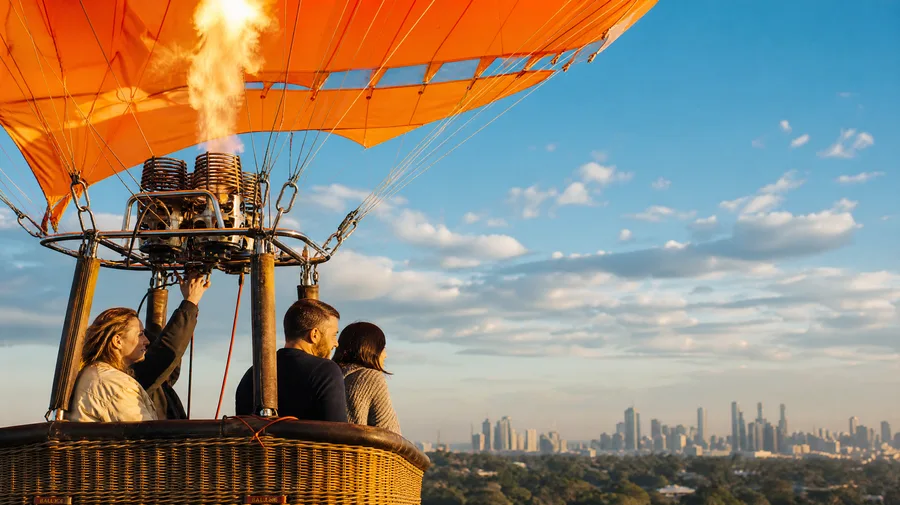
Floating above the city skyline feels calm in a way that surprises first-time flyers. There is no engine drone, no cockpit window glass, and zero wind buffeting your face because the craft travels at the exact speed of the surrounding air mass. The only sound is the intermittent blast of liquid propane from the burner heads.
Between burner bursts, you hear suburban sounds clearly. Train horns sound near Richmond Station. Lorikeets chatter in river gums along the Yarra. From 2,000 feet, the Melbourne Cricket Ground looks like a clean architectural model sitting on green felt, while the glassy facade of the Eureka Tower catches the morning sun.
Taking a hot air balloon ride melbourne trip requires a few small preparations to stay comfortable:
- Dress in sensible layers: cold ground air gives way to radiant burner heat warming the top of your head in flight.
- Attach secure camera lanyards: dropping a phone from 1,800 feet into a residential courtyard means it is gone forever.
- Skip large luggage: basket floor space is limited, so backpacks and bulky jackets must stay inside the chase van.
- Follow landing posture directions: crouching low and holding the rope handles keeps your back cushioned during bumpy turf touchdowns.
Booking a victoria hot air balloon outing offers a visual perspective you cannot get from any skyscraper observation deck. The grid layout designed by Robert Hoddle in 1837 spreads out beneath you with complete clarity, framed by the Dandenong Ranges to the east and the blue waters of Port Phillip Bay to the south.
By 8:00 AM, the envelope is deflated, packed into its canvas bag, and loaded onto the trailer. Commuters on the Eastern Freeway are stuck in rush-hour gridlock while you ride back into town with windblown hair and clean morning memories.
Frequently Asked Questions about do hot air balloons land where they take off from
Do hot air balloons land where they take off from during city flights?
No. Hot air balloons cannot steer against wind currents, so they travel downwind from the launch point. Flights land in parks, golf courses, or sports ovals several kilometers away, and a ground chase crew drives passengers back to the meeting point.
How do pilots choose where to land in Melbourne?
Pilots monitor wind direction continuously and identify large public reserves, equestrian parks, or school grounds along their flight trajectory. Commercial operators maintain detailed maps of pre-approved landing zones throughout Melbourne and suburban Victoria.
Can a hot air balloon return to its launch site if the wind changes?
It is theoretically possible if opposing wind directions exist at different altitudes, known as a box wind. However, this weather phenomenon is uncommon, and pilots always plan for a one-way flight with an off-site landing.
Quick Reference
- Flights are one-way journeys with no return to the launch oval
- Ground chase crews follow by road to provide return transport
- Typical flight distance spans between 5 and 20 kilometers
- Landing locations depend strictly on morning wind speed and heading
Book your hot air balloon melbourne experience:
The Bottom Line
Every dawn flight across Melbourne is a one-way trip shaped by atmospheric currents. Not knowing the exact landing spot until 15 minutes before touchdown is part of the charm of traditional lighter-than-air flight. If you want to see the city awake from a quiet vantage point high above the rooftops, book your dawn flight and let the morning breeze pick the destination.
Read more about hot air balloon melbourne.